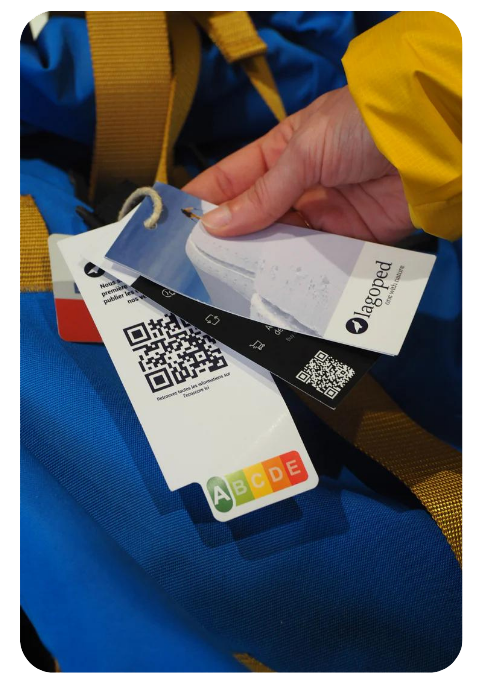
Understanding the Basics of the Product Environmental Footprint (PEF)

Part One:The Basics


Winter is coming.❄️

Last week we had the pleasure of presenting to joint members of the European Outdoor Group (EOG) and the Bundesverband der Deutschen Sportartikel-Industrie e.V. (BSI). We discussed why a standardized approach to environmental impact assessment is crucial for the outdoor sector. Especially as brands aim to measure and report their environmental impact accurately.

There were many great questions, and we wanted to share a snapshot of the key takeaways from that presentation here.

PEF is a standardized approach developed by the European Commission to measure and communicate products’ environmental footprint throughout their lifecycle. It ensures consistent environmental claims across the EU, enabling brands to compare their products fairly and transparently.

The Environmental Footprint, or EF, is a method developed to help companies compare and improve their environmental impact. It provides a common set of rules tailored for the European market. They are called the Product Environmental Footprint Category Rules (PEFCR).

The PEFCR provide specific guidelines for calculating product impacts, covering 16 environmental categories such as climate change, resource use, and water consumption.

For outdoor brands, sustainability is more than a trend—it’s a core value. The PEF methodology offers a standardized, EU-approved way to assess and reduce Scope 3 emissions, which often make up the majority of a brand’s environmental impact. By using PEF, brands can evaluate sourcing choices, material selection, and production processes to drive sustainability.

* Standardization: PEF provides a consistent method for comparing products across sectors.

* Regulatory Compliance: As EU regulations on environmental claims tighten, PEF ensures compliance.

* Holistic Approach: The methodology covers the full product lifecycle, from raw materials to end-of-life.

* Consumer Trust: With data-backed assessments, PEF builds consumer confidence in your environmental claims.

The Product Environmental Footprint (PEF) method offers a standardized approach to measuring a product’s environmental impact across its entire life cycle, aligning with ISO standards 14040 and 14044. It’s a comprehensive way to understand the full environmental impact of a product, from raw material extraction to end-of-life disposal.

PEF follows the Product Environmental Footprint Category Rules (PEFCR), which provide detailed guidelines for specific industries. For example, the PEFCR for Apparel & Footwear v2.0 covers the entire product lifecycle for this sector. PEF uses EF Mid-point Indicator 3.1 for impact assessment, which acts like “checkpoints” for environmental impacts, such as resource use and pollution, before assessing the overall harm to health or the planet. These indicators help brands identify the stages in their product’s lifecycle—like production, transportation, or disposal—that have the most significant environmental impacts.

To ensure fair comparisons and consistency, PEF uses European weighting and normalization factors, allowing it to be applied broadly across different sectors and products, while incorporating 16 distinct environmental impact indicators.
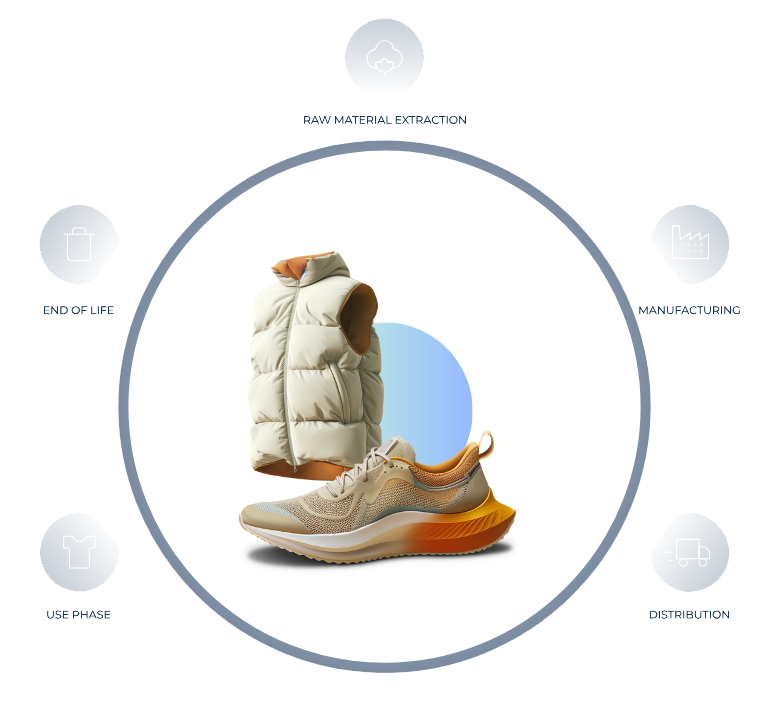
PEF is powered by an extensive database of over 5,500 datasets from sources like Ecoinvent, Blonk, and Thinkstep, providing detailed, diverse data for accurate impact analysis. Additional databases offer further enrichment to results, enabling brands to fine-tune their assessments based on specific materials or processes.

The PEF Score reflects the total environmental footprint of a product over its expected lifespan. For instance, if you have a pair of shoes designed to last a year, the PEF will calculate the environmental impact based on that full year of use. Longer-lasting products will generally have a lower impact per day because the environmental cost is spread over a more extended period.

The PEF methodology offers a powerful, standardized framework for outdoor brands to measure, reduce, and communicate their environmental impact. By using PEF, companies can ensure compliance with EU regulations, build consumer trust, and take a holistic approach to sustainability. From sourcing raw materials to managing end-of-life disposal, the PEF methodology provides a consistent way to evaluate and improve a product’s environmental footprint across its entire lifecycle.

In Part 2, we’ll dive deeper into the lifecycle analysis process. We’ll explore how PEF helps track long-term environmental progress, and look at a real-world example of PEF in action. Stay tuned to see how this methodology can drive even greater sustainability for your brand.

Cant wait for part two? Sign up for a demo

French Score also known as “Coût environmental”

In the ever-evolving realm of environmental sustainability, staying ahead of regulatory shifts is key. At Peftrust, we pride ourselves on not just keeping pace but leading the way.

Since March 2024, we’ve been pioneering a groundbreaking initiative within textile sustainability:

The incorporation of the French Score, known as “Coût Environnemental” into our digital LCA platform for environmental assessment.

While the public unveiling of this score occurred recently, our clients have been reaping its benefits for more months now, affording them a significant edge in reaching their sustainability goals.

The French Score represents a pivotal development stemming from France’s Ministry of Ecological Transition and ADEME’s collaborative efforts.

A cornerstone of the country’s Climate and Resilience Law, the “Affichage Environnemental” is a requirement that proposes assigning a score in the form of a numerical value to products, to serve as a tangible indicator of their environmental impact.

Much like price conveys financial cost, the Eco-Score illuminates the ecological toll. It is empowering consumers to make informed choices and incentivizing producers to embrace more sustainable practices.

Integrating the French Score: Enhancing Sustainability Metrics

Our integration of the French Eco-Score into our platform is not merely a response to regulatory requirements. It’s a proof of our commitment to help fashion brands, manufacturers, and suppliers align their impact with their sustainable values.

Two French additional impact categories

The French Government itself has acknowledged the inadequacy of solely assessing carbon impact when evaluating environmental impact comprehensively. They consider a few more criteria.

As a result, we have expanded our environmental impact categories beyond the 16 PEF indicators to include the two French specific categories.

  • The first key area we addressed in this integration is the consideration of End-of-Life (E-O-L) Exports Outside Europe. This entails a calculation that factors in the probability of being recycled after waste based on product composition. Products containing natural fibers have a higher likelihood of being recycled after waste compared to those with synthetic fibers, impacting the final Score accordingly.

  • The second area addressed by our platform is Microfiber Release, a critical and growing environmental concern. We employ sophisticated algorithms to calculate the potential release of microfibers during the lifecycle of textile products, considering factors such as fiber type and production processes.

Accounting for Emotional Durability

Finally, we also integrate Emotional Durability in the calculations. This is a multifaceted metric that evaluates 5 different factors that contribute to the longevity and hence sustainability of the product: traceability display, raw materials, commercialization duration, range breadth, and repair incentive.

By integrating Emotional Durability into our assessments, we provide a holistic view of product sustainability beyond conventional metrics. The durability aspect of clothing is often overlooked yet crucial. Without it, erroneous scores can arise, leading to misleading comparisons where synthetic fibers such as polyester may appear more favorable than natural fibers like cotton.

Also, focusing on durability allows to reduce environmental impact, waste levels, and resource consumption. This proactive approach ensures regulatory compliance and eventually can translate into
higher prices, lower costs, and enhanced brand loyalty.

Peftrust’s Unique Edge

What sets Peftrust apart is not just our ability to adapt to regulatory changes but our proactive approach in anticipating and integrating them impeccably into our platform.

While competitors scramble to retrofit their systems, our clients enjoy a unique advantage, assured of compliance and ready for market competitiveness. Our platform’s architecture is engineered to accommodate diverse regulatory frameworks regardless of geographical jurisdiction, as well as different lifecycle stages and impacts across fashion value chain. Regulatory fulfillment isn’t a hurdle for us, but rather an inherent feature that we know serves our clients’ best interests.


In addition, our commitment to excellence extends beyond mere compliance. While government-provided tools like Ecobalyse offer primary assistance, we surpass these boundaries offering unparalleled depth and granularity in environmental assessment. While Ecobalyse serves its purpose for basic calculations, our platform provides a comprehensive suite of tools and data sources, ensuring precise calculations for even the most complex fabrics and supply chain specificities.

Moreover, transparency and accountability are foundational pillars of our methodology. Peftrust subjects its methodology to rigorous scrutiny, undergoing biannual reviews to ensure the highest standards of accuracy and reliability. Trust isn’t just earned, it’s cultivated.

In the dynamic landscape of sustainability, Peftrust stands as your steadfast fashionally, navigating legislative complexities and delivering actionable insights. With the French Eco-Score integrated into our platform, you can now showcase your commitment to environmental stewardship and maintain a competitive edge in today’s increasingly eco-conscious market. As additional countries introduce their unique scoring systems, rest assured that we are equipped to seamlessly incorporate them into our algorithms, ensuring our clients remain at the forefront of sustainable practices and compliant with any existing regulations.

Getting Started with Product Environmental Impact Evaluation

Jumpstart any sustainability journey with our step-by-step guide — an essential read for professionals in product sustainability, whether affiliated with apparel, footwear, or home brands.  

Continue reading

Durability in Fashion: From Regulation to Innovation

The Durability Challenge: Embracing Sustainable Practices for Fashion Brands and Consumers

What challenges are brands facing? What are the solutions for making collections sustainable? How can brands and consumers act in favor of sustainability? Discover the answers in this article.

Continue reading