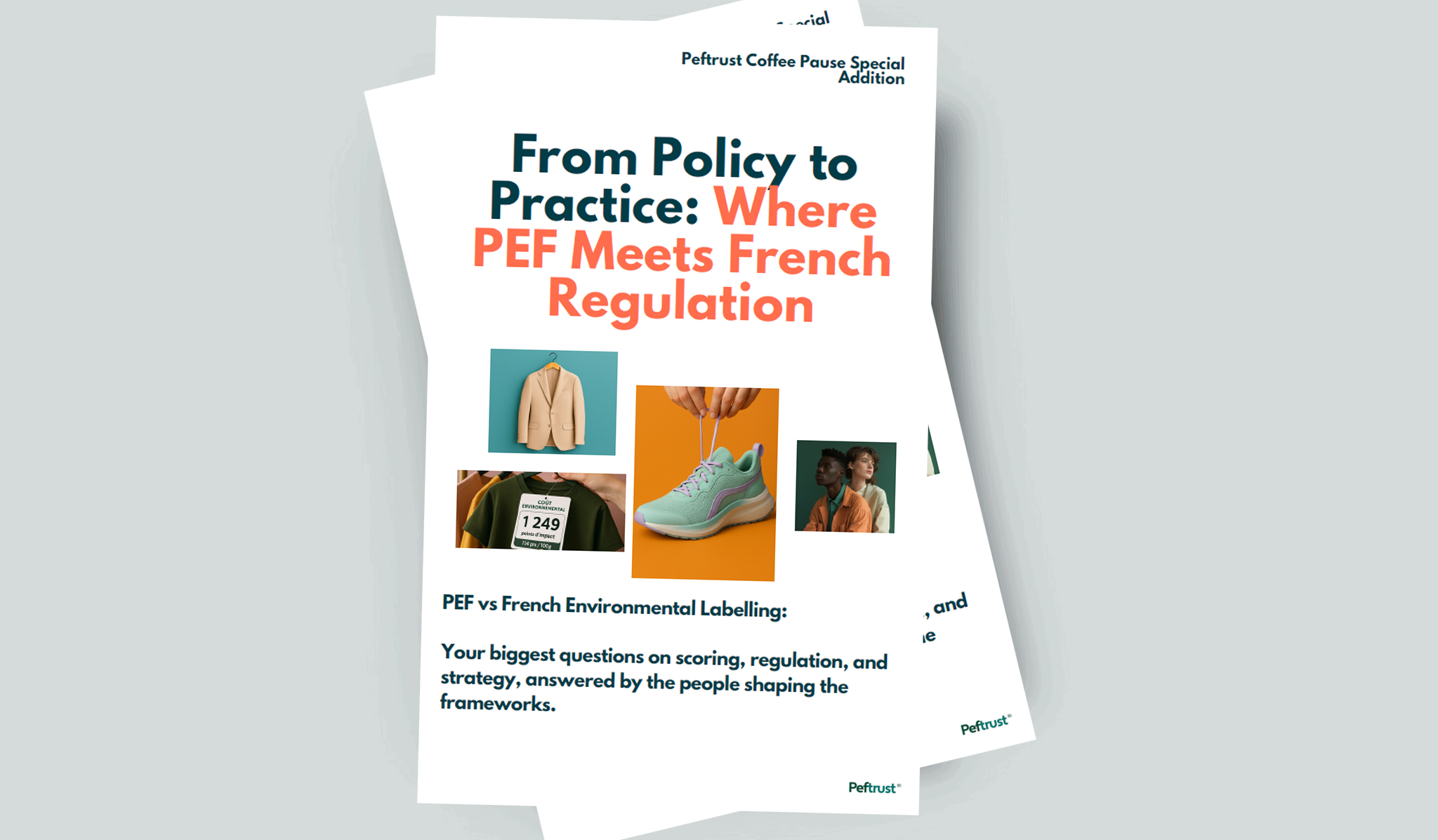
France is officially launching its Environmental Cost labelling framework (Ecobalyse), and the European Union is accelerating alignment around the Product Environmental Footprint (PEF). For apparel, footwear, and textile brands, this marks a turning point: environmental scoring is moving from policy discussion to operational reality.
This eBook explains how France’s Environmental Cost system and the EU Product Environmental Footprint (PEF) methodology intersect, what data is required today, and how upcoming regulations such as ESPR, Green Claims, and Digital Product Passports will reshape product sustainability strategies across Europe.
Built from a live “Ask Them Anything” expert session, this guide cuts through the confusion around PEFCRs, French environmental labelling, and score communication rules, offering a practical roadmap for brands preparing for compliance, eco-design, and product-level life cycle assessments.
What you’ll learn inside:
- PEF vs French Environmental Cost: what’s aligned and what’s different: understand how Ecobalyse and the Apparel & Footwear PEFCR work together, why France is acting as a testbed for EU-wide harmonisation, and what this means for future European standards.
- Regulatory timelines and what’s coming next: get clear on France’s environmental labelling decree, the upcoming PEF methodology revision (2026–2027), and how ESPR and Green Claims are expected to impact sustainability claims and Digital Product Passports.
- Mandatory vs optional data inputs: learn exactly what’s required to calculate Environmental Cost scores today (materials, weight, manufacturing countries), how default datasets are used, and how supplier-specific data can improve accuracy over time.
- Why the PEF single score can’t be used (yet): discover why aggregated PEF scores are currently restricted for apparel and footwear, what can be communicated instead, and how brands can still use PEF internally for benchmarking and eco-design.
- From compliance to strategy: see how brands are already using product-level LCAs to identify impact hotspots, engage suppliers, optimise materials and durability, and prepare for Digital Product Passport requirements.
The eBook features expert insights from Pascal Dagras (Ecobalyse, French Ministry of Ecological Transition) and Emilie Carasso (Director of Sustainability & Policy at 2B Policy), who explain how today’s French framework is actively shaping tomorrow’s EU sustainability regulations.
Their message is clear: PEF is the long-term foundation for environmental scoring in Europe, and brands that engage now will be better positioned for ESPR, DPPs, and future performance requirements.
If you’re navigating environmental labelling in France, EU Product Environmental Footprint, Apparel & Footwear PEFCRs, or product-level LCA implementation, this guide gives you a concrete, practical starting point
 Download the eBook to understand how PEF, Ecobalyse, ESPR, and Digital Product Passports connect, and why now is the moment to move from pilots to production.